
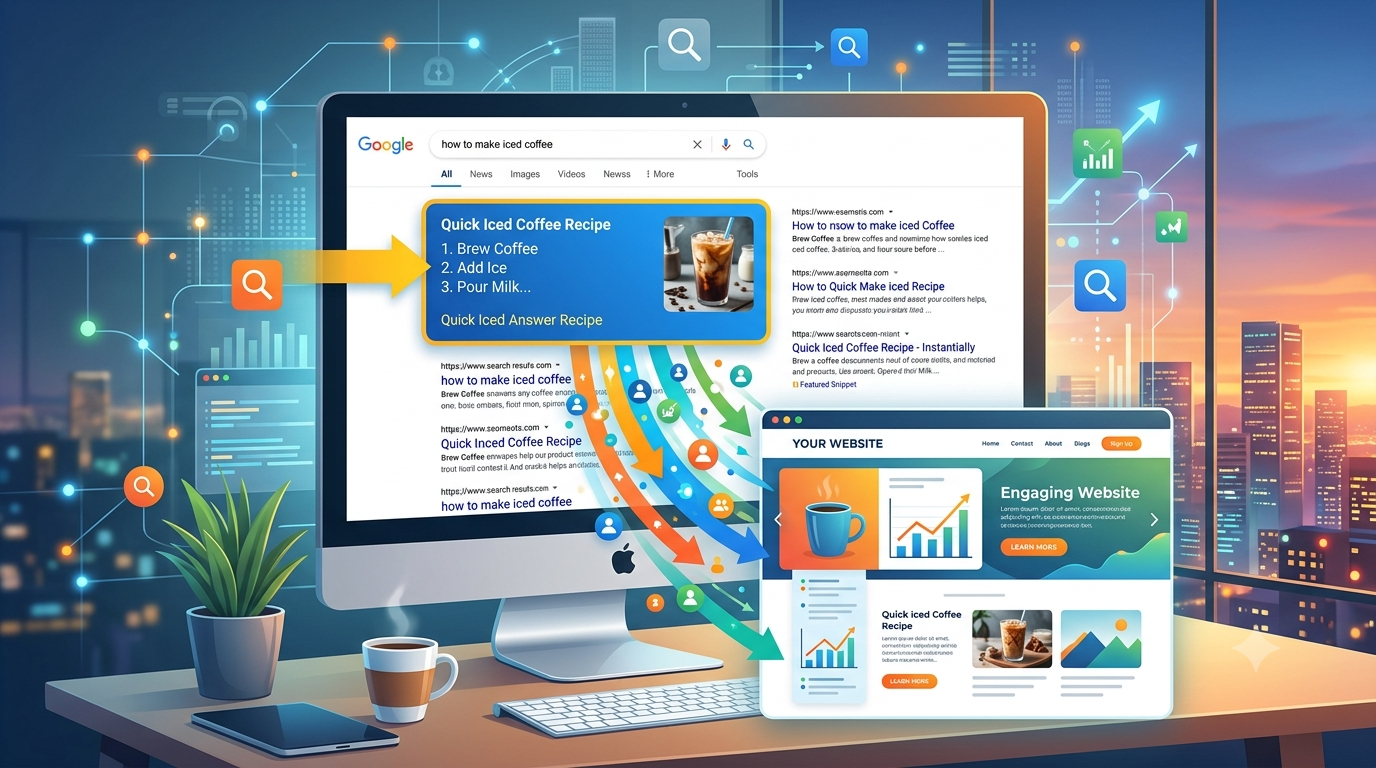
Google used to be a simple matchmaker. You typed in a query, it gave you ten blue links, and you clicked through to find your answer.
That model is pretty much dead.
Today, Google wants to be the answer engine, not the middleman. Between AI Overviews, featured snippets, knowledge panels, and interactive tools, users often get everything they need without ever leaving the search results page.
If you have noticed your even though your keyword rankings haven’t changed, you are watching a zero-click search happen in real time. It feels frustrating, especially when you spent hours creating that content. But zero-click searches do not mean organic marketing is useless. You just have to change how you measure success and adapt your digital marketing strategy to fit the new search landscape.
Here is how you can still capture traffic, build brand authority, and turn Google’s new layout to your advantage.
Understand Why Google Answers First
Before jumping into tactics, it helps to see what Google is actually trying to do.
Google wants to keep users on its page as long as possible. When someone searches “what time is it in London” or “how many feet in a mile,” they do not want to read a 1,200-word blog post. They want a quick number. Google gives it to them instantly.
That makes total sense for simple facts. The problem is that Google now tries to answer complex questions too. It pulls snippets from three different sites, summarises them with AI at the top of the screen, and leaves the original creators fighting for whatever attention is left below the fold.
If your content only answers basic factual questions, you are going to lose that traffic. To survive, you need to offer things an AI summary cannot easily steal.
Target “Click-Needy” Keywords
Not all searches are created equal. Some topics naturally require a user to click through, while others are doomed to zero clicks from the start.
Stop putting all your energy into simple definition keywords like “what is digital marketing.” Instead, shift your approach toward zero-click search SEO tactics that target topics demanding a deeper dive.
Focus on queries that involve:
- Complex decision-making: Comparison guides, product reviews, and software choices.
- Templates and tools: Downloadable spreadsheets, code snippets, or interactive calculators.
- Nuanced tutorials: Step-by-step guides where layout, visuals, and specific context matter.
- Personal opinions and stories: First-hand accounts, case studies, and original industry research.
An AI Overview can summarise what a strategy is, but it cannot share what happened when your team actually tried it last month. That experience is your competitive moat.
Write for the “Information Gap”
If you want people to leave Google and visit your website, you have to give them a reason to click. That means creating an information gap.
Give away the quick answer early so search engines view your page as helpful, but structure the rest of the page so the user wants the full story. Think of your opening paragraph as a teaser.
If your article is about resolving a specific web error, state the core fix right away. Then, spend the rest of the piece walking through the edge cases, prevention methods, and common mistakes people make while trying to fix it. The casual user gets their quick answer, but the person who actually needs real help will click through to read the full guide.
Optimise for Citation, Not Just Clicks
Sometimes, you won’t get the direct click, and that is okay. The next best thing is learning how to capture traffic from AI Overviews by getting your brand name cited directly inside the AI summary or featured snippet.
When Google generates a summary, it links back to its sources. If your brand is consistently named as the source for industry insights, pricing data, or expert commentary, you gain massive brand authority.
To make your content easy for Google to cite:
- State facts clearly: Use direct sentences like “In 2026, the average cost of X is Y.”
- Use clear headings: Break your article down into logical sections with descriptive headings.
- Add original data: Run small surveys or publish internal data. AI engines love citing unique stats because they cannot generate new data on their own.
When users see your site listed as the trusted source over and over again, they start searching for your brand directly. That is traffic Google can’t take away from you.
Turn Your Site into a Destination
If all your website offers is generic advice, people have no reason to visit. They can get generic advice right on the search page.
To win in a zero-click world, build a site that offers an experience. Add clear visuals, custom infographics, interactive tools, and a distinct voice. Make your content feel like it was written by an actual human who knows the topic inside and out.
When readers realise your site is consistently more helpful than a scraped search summary, they stop relying on Google to find you. They bookmark your blog, subscribe to your newsletter, or type your domain directly into the bar.
Frequently Asked Questions
What is a zero-click search?
A zero-click search happens when a user performs a search on Google or another engine but leaves without clicking on any website link. This occurs because the search engine provides the complete answer directly on the results page using AI Overviews, featured snippets, knowledge panels, or local maps.
Does a zero-click search mean SEO is dead?
No, SEO isn’t dead, but the metrics for success have shifted. While raw click volume on simple factual queries has decreased, users who do click through after reading an AI summary often have higher intent and convert better. Modern strategy focuses on brand visibility, Generative Engine Optimization (GEO), and capturing high-intent commercial traffic.
How do I know if zero-click searches are hurting my website?
Check your Google Search Console data. If your impressions remain steady or grow while your total clicks drop on specific informational pages, zero-click features like AI Overviews or featured snippets are likely satisfying user intent directly on the search engine page.
Conclusion
Zero-click searches are changing search engine optimisation, but they aren’t the end of it. By focusing on depth, sharing real experience, and leaning into modern search optimisation, you can still capture high-intent users who want more than a fast summary.
At Bemunchie Online, we’re a leading GEO marketing agency in the UK, helping businesses navigate changing search landscapes. From web design to targeted digital marketing, we build strategies designed to drive real leads, not just hollow clicks. If you are ready to protect your traffic and make your site a true destination, get in touch with the Bemunchie Online team today.
